Asbestos: what the Royal Decree of 19 December 2025 changes for every company, not only for asbestos removal contractors
Exposure limit divided by ten since 22 December 2025, electron microscopy mandatory on 21 December 2027, threshold of 0.002 fibre per cm³ on 21 December 2029.
Belgium transposed European Directive 2023/2668 at the end of December 2025. The occupational exposure limit has been divided by ten, the measurement technique is about to change, and a second reduction is already scheduled for 2029. The resulting obligations do not apply only to asbestos removal contractors.
What the decree changes
The Royal Decree of 19 December 2025 amending the Code on well-being at work with regard to asbestos was published in the Belgian Official Gazette on 30 December 2025 and took effect on 22 December 2025. It transposes Directive (EU) 2023/2668 of 22 November 2023, which amends Directive 2009/148/CE on the protection of workers from the risks related to exposure to asbestos at work. The European transposition deadline was set at 21 December 2025.
The amendments concern Title 3 of Book VI of the Code on well-being at work. They cover four areas: the occupational exposure limit, the measurement technique, training requirements, and the rules applicable to removal work. The European Commission has published accompanying guidelines on the management of asbestos risks at work.
The exposure limit in three steps
This is the change with the heaviest consequences. The occupational exposure limit now follows a three-stage timeline:
- Before 20 December 2025: 0.1 fibre per cm³ of air, as an eight-hour time-weighted average.
- Since 22 December 2025: 0.01 fibre per cm³, a tenfold reduction.
- From 21 December 2029: 0.002 fibre per cm³.
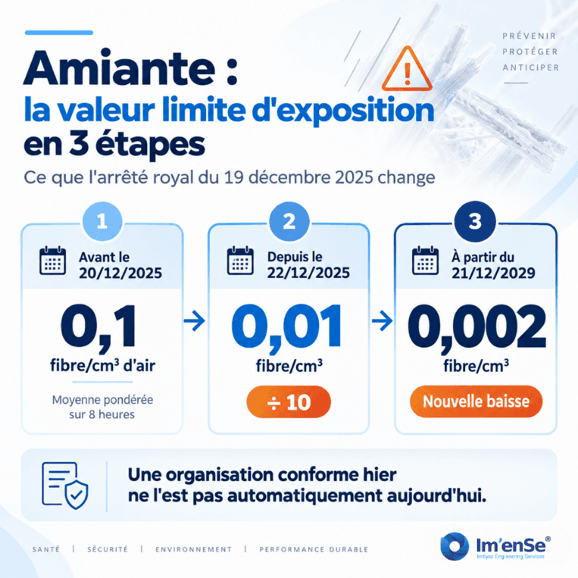
Dividing the limit value by ten is not a matter of moving a slider. It changes the design of work areas, the sizing of containment systems, the selection of respiratory protection and the control arrangements. A site organisation that met the previous threshold does not automatically meet the new one.
The move to electron microscopy
Until now, asbestos measurements in Belgium were carried out by optical microscopy. From 21 December 2027, measurements will have to be performed solely by scanning electron microscopy. This technique detects the thin fibres that optical microscopy cannot distinguish, which is indispensable for verifying compliance with a threshold ten times lower.
There are two practical consequences for client companies. The first is budgetary: the unit cost of a measurement increases. The second is contractual: specifications and framework contracts signed with laboratories and asbestos removal companies must be reviewed to incorporate the measurement technique required from the end of 2027, failing which the results received will not be compliant.
The asbestos inventory, a permanent obligation often treated as an archive document
Article VI.3-4 of the Code requires every employer to draw up an inventory of all asbestos and asbestos-containing materials present in all parts of the buildings, including any common areas, as well as in work equipment and protective equipment. This inventory is not reserved for owners of older industrial buildings. It applies to every employer, in all three regions of the country.
Three points are regularly misapplied in the field:
- The inventory must cover work equipment, not only the building fabric. Flange gaskets, pipe insulation, brake linings, thermal protection plates in electrical cabinets: these items are frequently absent from inventories.
- The occupational safety prevention adviser and the occupational physician prevention adviser each issue a written opinion on the inventory, on its updating and on its extension. The absence of these written opinions is a shortcoming that can be identified during an inspection.
- The inventory is kept available to the officials responsible for supervision. An inventory that is not accessible on site amounts, in practice, to no inventory at all.
Where the inventory reveals the presence of asbestos or asbestos-containing materials, a management programme must be drawn up. That programme must state clearly what will happen to the materials and how worker exposure will be kept as low as possible.
One point is worth flagging because it comes up often in exchanges with service providers. The issuing of private certificates describing a building as asbestos-free or asbestos-safe has no regulatory basis under well-being at work legislation. Such documents do not replace the legal inventory required by Title 3 of Book VI.
The breaking point: maintenance and subcontracting
The regulations provide that, before starting work on installations, machinery or boilers, the employer must examine whether asbestos or asbestos-containing materials have to be handled first, giving priority to removal over other forms of handling such as repair or encapsulation. Work cannot start without an inventory.
This is where the chain most often breaks. An unplanned maintenance intervention, entrusted to a subcontractor who has not received the inventory, on a piece of equipment that nobody knows contains an asbestos gasket. The sequence is commonplace, it is documented, and it produces an unmeasured exposure that will appear in no indicator.
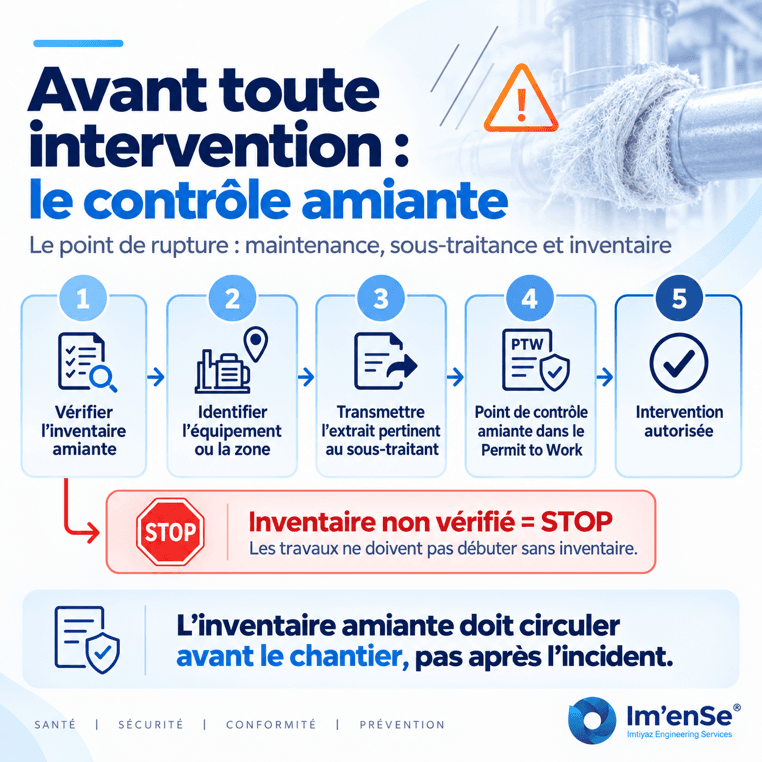
Three mechanisms reduce this risk in a verifiable way: systematic transmission of the relevant extract of the inventory in the tender file of every external company, inclusion of an asbestos check in the permit to work procedure, and updating of the inventory at each accidental discovery rather than once a year.
What to check now
- Date of the last update of the asbestos inventory, and effective coverage of work equipment and not only of buildings.
- Presence of the written opinions of both prevention advisers on the inventory and on its latest update.
- Existence of an up-to-date management programme if the inventory is positive.
- Review of contracts and specifications with laboratories and removal companies, for the measurement technique applicable from 21 December 2027.
- Integration of an asbestos check into the permit to work procedure and into the file handed to external companies.
- Verification of the training certificates of workers liable to work on or near asbestos-containing materials.
Sources
- Royal Decree of 19 December 2025 amending the Code on well-being at work with regard to asbestos, Belgian Official Gazette of 30 December 2025
- Directive (EU) 2023/2668 of 22 November 2023 amending Directive 2009/148/CE
- Code on well-being at work, Book VI, Title 3 · Asbestos
- FPS Employment, Labour and Social Dialogue · Asbestos and asbestos removers section
- European Commission · guidelines on the management of asbestos risks at work