HSE Principle: "Preventing explosions = identifying + controlling explosive atmospheres"
ATEX Regulation (Explosive Atmospheres) EU Directive 2014/34/EU (equipment) + 1999/92/EC (workplaces), transposed…
ATEX Regulation (Explosive Atmospheres)
EU Directive 2014/34/EU (equipment) + 1999/92/EC (workplaces), transposed in France by Decree 2015-799 and the Labor Code.
Objective: Eliminate ignition risks in areas with explosive atmospheres (gases, vapors, dusts).[1][2][3]
Step 1: Risk Assessment and Zoning
Employer obligation: Conduct a comprehensive risk analysis (DUERP including ATEX) to identify:
- Combustibles: flammable gases, vapors, dusts
- Oxidants: O₂ > 11%, atmospheric pressure
- Sources of ignition: sparks, flames, hot surfaces
Zone classification (based on frequency/duration of explosive atmosphere):
Gases / Vapors
Dusts
Likelihood
Zone 0
Zone 20
Permanent (>1000 h/year)
Zone 1
Zone 21
Occasional (10–1000 h/year)
Zone 2
Zone 22
Accidental (<10 h/year)
Zoning is indicated by regulatory signs and documented in the Explosion Protection Document (DPE).
Step 2: Preventive Measures (Hierarchy)
- Prevent formation of explosive atmospheres
- Capture dust/vapor sources
- Inerting (N₂ / CO₂)
- Increase dust particle size
- Prevent sources of ignition
- ATEX-certified equipment (marking Ex II 2G)
- Static controls (grounding)
- Prohibitions (smoking, non-ATEX tools)
- Limit effects of an explosion (if 1 and 2 are not possible)
- Explosion vents
- Explosion suppression
- Compartmentalization
Step 3: Equipment Requirements (Directive 2014/34/EU)
- Mandatory marking: Ex + explosion symbol + group (I/mines, II/surface) + category (1/2/3)
- Certification: notified body for zones 0/20/1/21
- Documentation: instructions, technical file (retain 10 years)
- 2026: 5th edition ATEX Guide + alignment with Machinery Regulation 2023/1230 (electronic documentation allowed)[1]
Step 4: Organization and Training
- Worker training: adapted to zone/exposure (ATEX safety training, hot work permits)
- High-risk work: written instructions, fire permit system
- Clothing: anti-static (EN ISO 11612)
- Maintenance: periodic checks of ATEX equipment
Audit and Compliance 2026
By 30 May 2026: full transposition of the revised ATEX Directive. Required actions:
- Verify existing equipment (re-certify if needed)
- Update DPE and zoning
- Refresher training + evacuation drills
- Supplier audits (ensure ATEX certificates are current)
Essential HSE Lesson
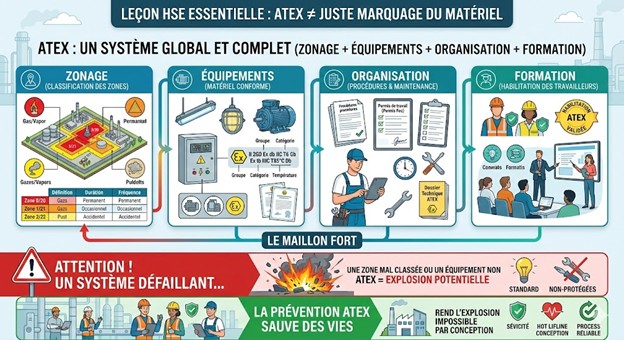
ATEX ≠ just equipment labeling: it is a comprehensive system (zoning + equipment + organization + training). A misclassified zone or non-ATEX equipment = potential explosion. ATEX prevention saves lives by making explosions impossible by design.
Sources
• ATEX 2026: When Prevention Changes Scale (Not Just Zoning) – Dekra Industrial • Standards Related to the ATEX Directive – IBF Solutions • Implementation of the New ATEX Directive 2014/34/EU – Ineris • Workplace Explosions: Regulations and Reference Texts – INRS • ATEX Regulation: Directive 2014/34/EU – Equipment and Systems • ATEX Zone Classification – Petzl • ATEX: Preventing the Risk of Explosion in the Workplace – Tennaxia • New and Global Approach – ATEX Directive • ATEX Zones: Definition and Marking of Explosion Risk Areas – Jungheinrich • ATEX (Explosive Atmospheres) – Tandem HSE • JOUE L96 of 29 March 2014 • ATEX Zoning and Hazardous Zone Classification – Dekra Process Safety • ATEX Equipment, Explosive Atmospheres, and Overzoning – Sigma HSE • Directive 2014/34/EU (PDF) • Each ATEX Zone Standardized According to Its Hazard Level – Zone-ATEX