Co-activity and subcontracting on large industrial sites: where risk concentrates
On large industrial sites, co-activity risks do not add up: they combine. What the Belgian legal framework requires, why external contractors are over-represented in accidents, and the two prevention levers that make the difference.
Large industrial sites accumulate structural risk factors: dozens of companies present at the same time, high workforce turnover, and operational environments that change as the works progress. Co-activity and the use of subcontracting are not occasional aggravating factors. They are permanent features of these environments.
In Belgium, the Code on well-being at work (Act of 4 August 1996) and the Royal Decree of 25 January 2001 on temporary or mobile sites set out a precise framework for managing these risks. That framework lays the foundations. On its own, it is not enough to reduce accident rates.
Why co-activity concentrates risk
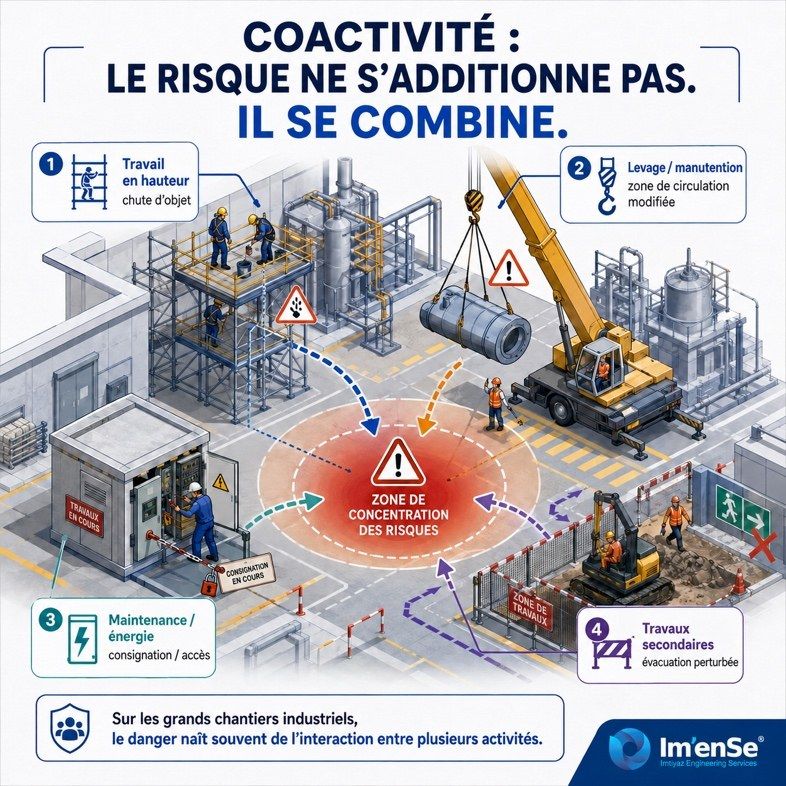
When several companies work simultaneously on the same site, risks do not simply add up. They combine. Work at height creates a risk for those working at ground level. An access route temporarily blocked by secondary works changes evacuation routes. Equipment moved by one team can end up in another team's working area.
Annual data from Fedris (the Belgian occupational accidents fund) consistently show that temporary agency workers and external contractors are over-represented in workplace accident statistics in Belgium. The factors are identified: shorter time on site, more limited knowledge of site-specific procedures and risks, and often insufficient integration with permanent teams.
At European level, EU-OSHA confirms that the construction sector accounts for a significant share of fatal occupational accidents, with co-activity and subcontractor management appearing as recurring factors in cause analysis.
The Belgian legal framework: what the regulations require
The Royal Decree of 25 January 2001 requires, for temporary or mobile sites above certain thresholds, the appointment of a safety and health coordinator. That coordinator is responsible for drawing up the safety and health plan during the design phase, and for its application during the execution phase.
The general prevention plan and the annual action plan, provided for by the Code on well-being at work, must explicitly cover the risks linked to co-activity and subcontracting. These documents are not administrative formalities. They form the operational reference that the companies working on site must align with.
Every subcontractor has an obligation to communicate the risks it introduces on site. The principal has an obligation to verify that this information exists and is integrated into the overall coordination.
Real-time field reporting as the first prevention lever
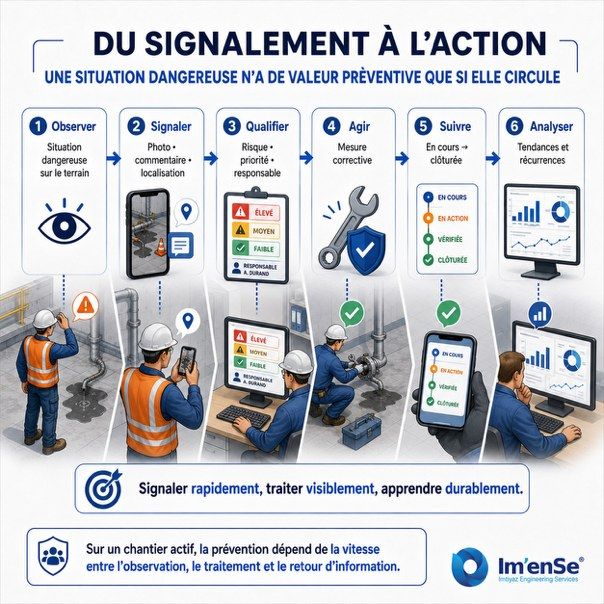
On an active site, conditions change quickly. An incident not reported within the hour can become an accident within the day. Rapid reporting of dangerous situations, near misses, and anomalies is the first active prevention mechanism available.
Two conditions are needed for this reporting to actually work. First, the process must be simple and accessible from the field, without administrative friction. Second, every report must trigger a visible response. Without feedback, people quickly stop reporting.
Mobile tools accessible from a smartphone, allowing a report to be filed in seconds with a photo and location, significantly reduce the delay between observation and handling. The issue is not technological. It is the reporting culture: people on site must understand that reporting protects them, rather than exposing them to consequences.
Making risk assessments dynamic
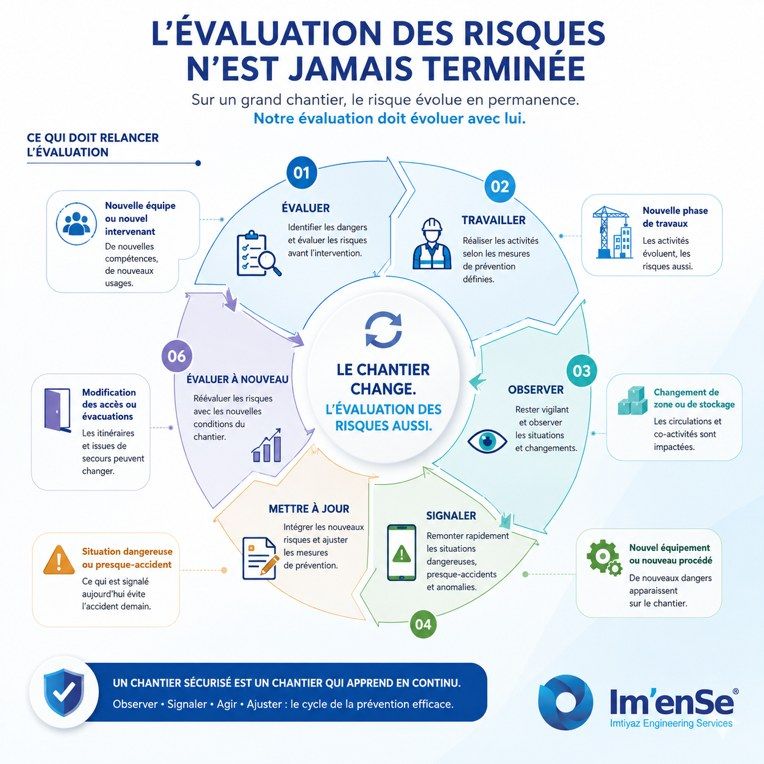
The prevention plan on a large site is not a fixed document drawn up once at the start of the project. The progress of the works, the arrival of new teams, and changes to access routes or storage areas continuously create new risks. A static assessment carried out at start-up no longer reflects operational reality after a few weeks.
Digitising prevention plans makes it possible to update them in real time, to incorporate risks reported from the field, and to make those updates immediately available to everyone on site, whatever company they belong to. It is a change of practice as much as a change of tool.
Continued in Part 2: work permits, verification of qualifications, and follow-up of corrective actions.