Machinery Regulation (EU) 2023/1230: what operating companies must prepare before 20 January 2027
One concept is enough to turn an operator into a manufacturer: substantial modification. Here is what the new Machinery Regulation changes before 20 January 2027.
Almost everything published on the new Machinery Regulation targets manufacturers. Yet the text creates direct exposure for companies that operate, modify, or integrate machinery. The point that concerns them comes down to one concept: substantial modification.
A regulation, not a directive
Regulation (EU) 2023/1230 of the European Parliament and of the Council on machinery was adopted on 14 June 2023 and published in the Official Journal of the European Union on 29 June 2023. It will apply from 20 January 2027, when it will replace Directive 2006/42/EC.
The difference in legal nature has concrete consequences. A directive sets objectives that each Member State transposes into national law, which produces differences in application across the twenty-seven. A regulation applies directly and uniformly, with no transposition. There will therefore be no Belgian transposing text to wait for, and no additional national deadline.
What remains under the former regime
Machinery placed on the market or put into service before 20 January 2027 remains subject to Directive 2006/42/EC. The Regulation only applies to machinery placed on the market or put into service after that date.
This rule is simple to state and complicated to apply across a real industrial fleet, because an older machine can shift into the new regime. That is the subject of the next section.
Substantial modification, the point that directly concerns operating companies
The Regulation applies to machinery in service that has undergone substantial modification. Any significant modification of machinery in service can turn its operator into a new manufacturer, with the full set of conformity obligations that status implies: risk assessment, technical file, declaration of conformity, marking, instructions.
The situations concerned are common in industry:
- Retrofitting an older production line with new controllers.
- Adding a robotic station or a cobot to an existing installation.
- Modifying a safety function, for example replacing a guarding system with a software-controlled device.
- Assembling several existing machines into one functional unit driven by a single control system.
- Significantly increasing the rate or capacity of an installation.
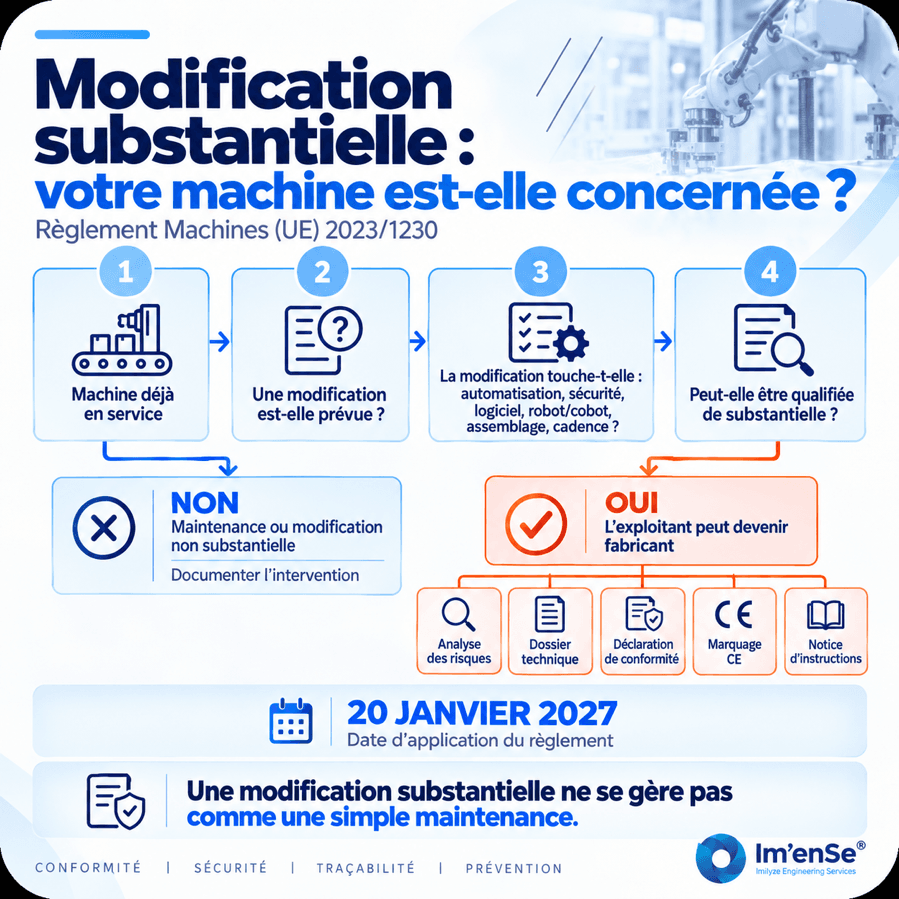
The question to settle internally, before January 2027, is not theoretical: who in the company decides that a modification is substantial, on what criteria, and who signs off. In many organisations, this decision is made implicitly by the maintenance department with no written record.
Software, cybersecurity, and artificial intelligence
The Regulation integrates technological developments that the 2006 directive did not cover. Software now falls within the scope of safety components. The text introduces explicit cybersecurity requirements for machinery with digital elements. It also addresses autonomous mobile machinery and systems that perform safety functions by means of artificial intelligence.
On the interface with the AI Regulation, the text has evolved since its adoption. The Machinery Regulation already provided that, for high-risk AI systems used as safety components, the technical requirements would be integrated directly into it. The Digital Omnibus on AI, which entered into force on 27 July 2026, clarified this mechanism: it removes machinery from the list of products subject to full dual conformity under the AI Regulation, and makes the Machinery Regulation the reference framework for AI-based safety functions. The Commission must integrate the full technical requirements through a delegated act by 2 August 2028 at the latest; until then, harmonised standards under the AI Regulation may serve as a presumption of conformity, while the essential health and safety requirements of the Machinery Regulation remain fully applicable.
For the operator, the consequence is that a software update is no longer a neutral maintenance act. If it affects a safety function, it falls within the machine's conformity.
The instructions for use
The general structure of the requirements for the instructions for use is maintained, but its content is expanded. For machinery incorporating digital functions, software, or connected interfaces, the instructions must now cover the risks linked to embedded software and its updates, the cybersecurity measures the user must observe, and, where applicable, the operating conditions in autonomous or semi-autonomous mode.
For the user, this means the instructions become a source of operational requirements to be carried into operating procedures and operator training, rather than only a document to be archived.
What remains to be done before January 2027
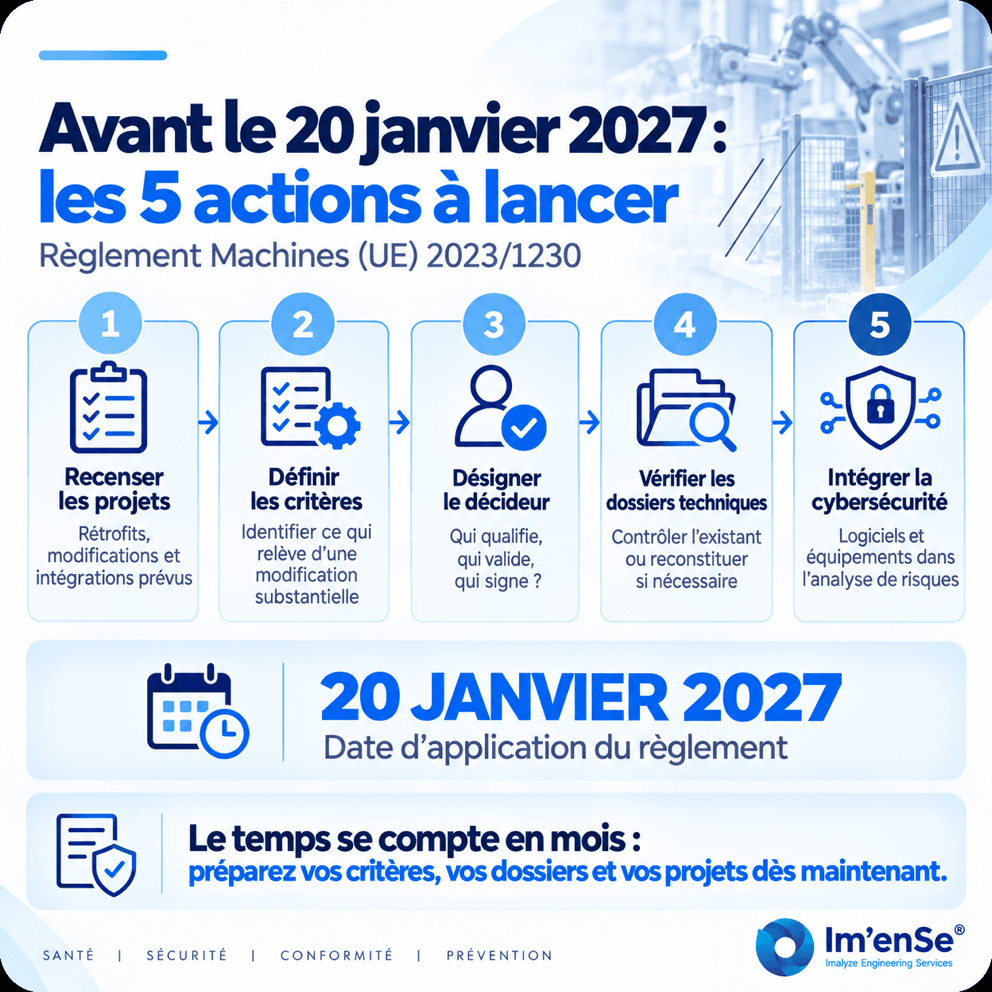
The remaining time is counted in months, not years. Five actions should be addressed without delay:
- Map out the modification, retrofit, and integration projects planned between now and 2027, and determine for each whether it will be completed before or after 20 January 2027.
- Define and write down the internal criteria that qualify a modification as substantial, and designate who makes that decision.
- Check the status of the technical files for machinery likely to be modified. A substantial modification to a machine whose original file cannot be found means the file must be rebuilt in full.
- Adapt purchasing and integration specifications for deliveries scheduled after 20 January 2027.
- Integrate production equipment cybersecurity into the risk assessment, in coordination with the IT department.
Sources
- Regulation (EU) 2023/1230 of the European Parliament and of the Council of 14 June 2023 on machinery, OJEU of 29 June 2023
- Directive 2006/42/EC on machinery
- Regulation (EU) 2026/1744 (Digital Omnibus on Artificial Intelligence), entered into force 27 July 2026
- Code du bien-être au travail (Belgian Code on Wellbeing at Work), Book IV · Work Equipment
- EUROGIP · occupational risk monitoring in Europe