Reintegration 3.0: what has changed in the Code on well-being at work since 1 January 2026
Preventive workstation adjustment request, formalised contact maintenance, registered invitations, medical force majeure reduced to six months: what changes since 1 January 2026.
The Royal Decree of 17 December 2025 amends the reintegration process and introduces a preventive component that did not previously exist. The text shifts part of the burden upstream, before incapacity occurs, and imposes new traceability requirements.
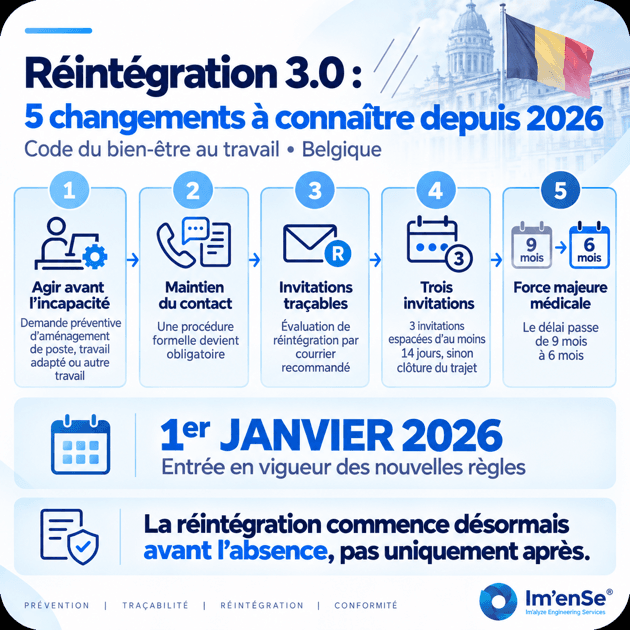
The text and its entry into force
The Royal Decree of 17 December 2025 amending the Code on well-being at work with regard to the reintegration of workers unable to work and the prevention of long-term absences was published in the Belgian Official Gazette on 30 December 2025. It entered into force on 1 January 2026. It forms part of the overall plan for the prevention and reintegration of long-term sick workers provided for in the 2025-2029 federal government agreement.
The legislator explicitly states that the purpose of these provisions is not to check whether the incapacity is justified, but to prepare for the return to work. This clarification has a practical effect: it delimits what the employer may and may not ask for under the new procedures.
Acting before incapacity occurs
This is the structural novelty of the text. A worker who believes they are at risk of becoming unable to work because of health problems can now ask their employer to examine whether an adjustment to their workstation, adapted work or other work is possible, in order to avoid a period of incapacity.
The employer is required to examine this request. It may seek the opinion of various prevention advisers depending on the nature of the problem: occupational physician, prevention adviser for psychosocial aspects, ergonomist, occupational safety prevention adviser.
For an internal prevention service, this means that a category of requests that was not formalised becomes a fully-fledged procedure, with an entry point, a processing deadline and traceability. The question to be settled internally is not whether these requests will arrive, but who receives them, in what format, and who documents the response.
Maintaining contact becomes a formal procedure
The company must put in place a formal procedure for maintaining contact with the worker who is unable to work. The key word is formal. An informal practice, left to the discretion of the line manager, does not meet the requirement.
A procedure of this kind must specify, at a minimum, who makes contact, how often, by what channel, and what may and may not be discussed. This is a sensitive point: the boundary between maintaining the relationship and pressure to return is thin, and it is the written procedure that gives it substance.

Traceability of invitations and closure of the process
Two provisions change how the reintegration process unfolds:
- Invitations from the occupational physician prevention adviser to the reintegration assessment must be sent by registered mail, in order to ensure traceability.
- If the worker has not responded to three invitations, spaced at least fourteen calendar days apart, the reintegration process is closed. The employer and the advising physician are informed.
These rules create additional administrative burden, but they also remove an ambiguity that generated disputes: whether the worker had actually been invited.
Medical force majeure: from nine to six months
The waiting period for requesting the opening of a medical force majeure procedure is reduced from nine to six months of incapacity for work. This change also applies to incapacity that began before 1 January 2026, which means a backlog of cases becomes eligible immediately.
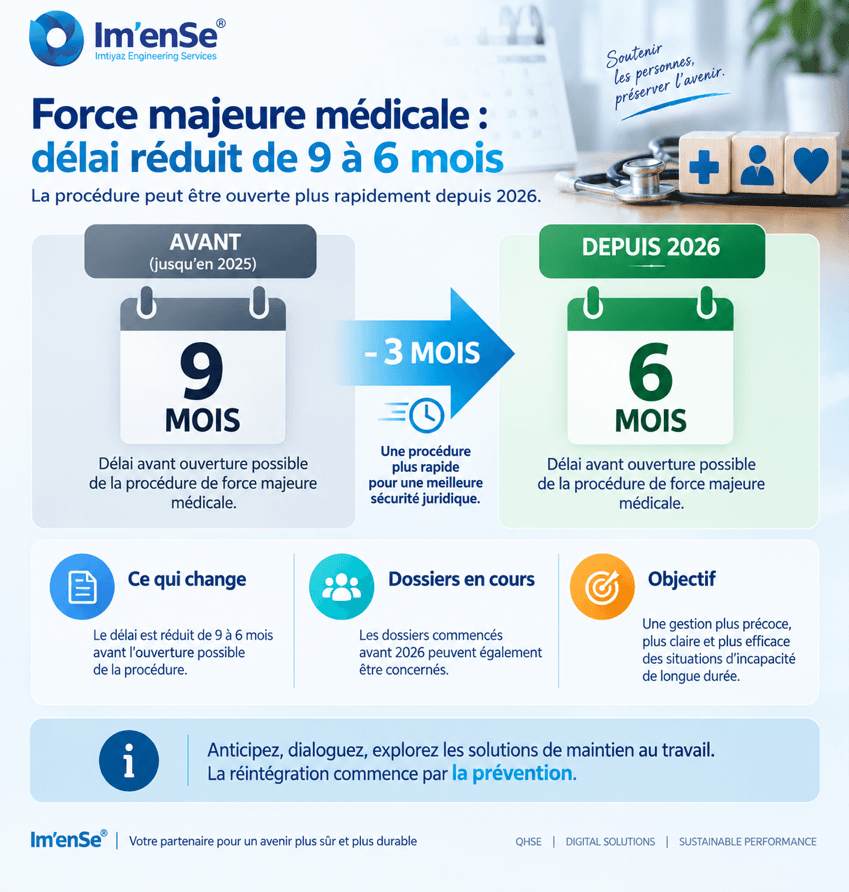
In practice, companies that track long-term incapacity must revise their monitoring tables: cases opened in 2025 cross the six-month threshold earlier than expected.
An expanded role for the prevention committee (CPPT)
The decree adds that the committee for prevention and protection at work may, within the scope of its duties, issue opinions on flexible work arrangements. The link with the prevention of long-term absences is direct: adjusting working time is one of the most commonly used levers for avoiding a period of incapacity or for organising a gradual return.
What the internal service must adapt
- Create and document the procedure for preventive requests for workstation adjustment, with an identified entry point.
- Draft the formal procedure for maintaining contact and have it validated by the prevention committee.
- Adapt the tracking of reintegration assessment invitations to incorporate registered sending and the count of the three invitations.
- Recalculate medical force majeure deadlines for ongoing cases, including those opened before 2026.
- Include these elements in the annual action plan and inform the line management, who is the worker's first point of contact in most cases.
Sources
- Royal Decree of 17 December 2025 amending the Code on well-being at work with regard to the reintegration of workers unable to work and the prevention of long-term absences, Belgian Official Gazette of 30 December 2025
- FPS Employment, Labour and Social Dialogue · Reintegration 3.0 news
- 2025-2029 federal government agreement, prevention and reintegration of long-term sick workers section