Revised ESRS: what the simplification of sustainability reporting really changes for the QHSE function
Fewer mandatory data points, but more rigor on the ones that remain. What the delegated act of 3 July 2026 changes for the QHSE function.
On 3 July 2026, the European Commission adopted the delegated act revising the ESRS standards. The number of mandatory data points drops by around 60%. For a mid-sized industrial company, though, the useful question is no longer how to produce its report, but what its customers can still ask of it.
Where the text stands
On 3 July 2026, the European Commission adopted two delegated regulations: one establishing the revised ESRS, which amend Delegated Regulation (EU) 2023/2772, known as Set 1 of July 2023, the other establishing a voluntary standard for companies not subject to the CSRD, the Voluntary Standard (VS), formerly known as VSME.
The text builds on the technical advice submitted by EFRAG on 3 December 2025, structured around six simplification levers. The Commission made its own adjustments, notably on materiality, reporting scope, and timeline. It is free to depart from EFRAG's advice, which is an advisory body.
The delegated act remains subject to the European Parliament and Council's scrutiny period, of two months, renewable. Barring objection, it enters into force four months and one week after its adoption, around 10 November 2026. The application timeline is as follows:
- Financial year 2026: companies already in scope have three options. Keep ESRS Set 1, apply the revised ESRS early, or use an intermediate approach combining Set 1 with certain targeted relief measures.
- Financial year 2027, report published in 2028: the revised ESRS become the sole applicable reference.
What changes in the standards, and what does not
The architecture stays the same. Twelve standards: ESRS 1 and ESRS 2 cross-cutting, E1 to E5 for environment, S1 to S4 for social, G1 for governance. Double materiality remains the foundation of the sustainability statement, and the principle of faithful representation is reaffirmed in ESRS 1 as the purpose of the report.
What changes is the burden and the method. According to EFRAG's estimate, the revision cuts the number of mandatory data points by around 61%, and more than 70% of data points overall, for an estimated reporting cost reduction of more than 30% per company. It would represent EUR 3.7 billion in cumulative savings for preparer companies between 2027 and 2031. Voluntary data points have been removed from the body of the standards.
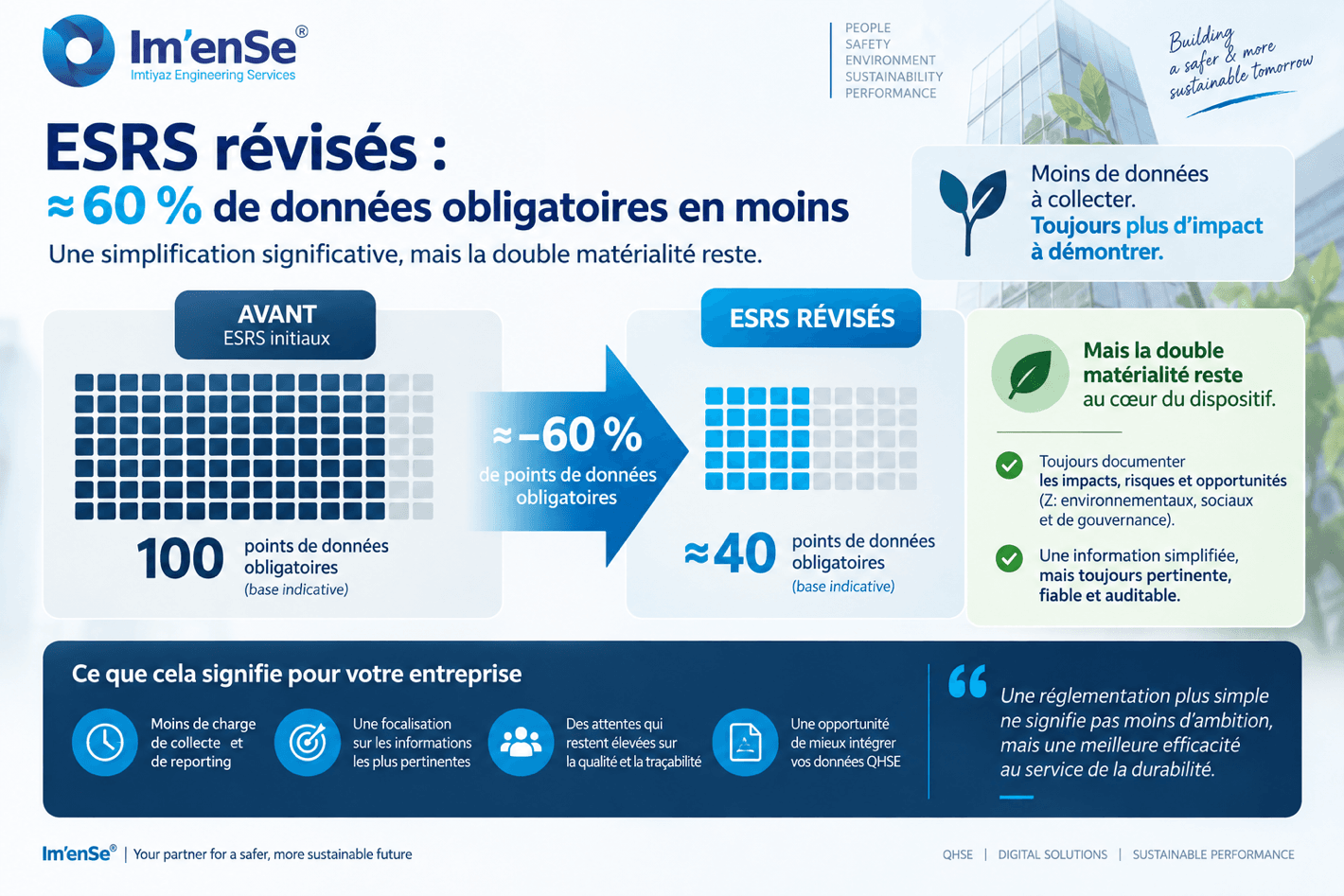
The most structural relief measures are the following:
- The double materiality analysis can be carried out top-down from the sustainability matters, rather than only from each impact, risk and opportunity taken in isolation.
- The so-called undue cost or effort mechanism is generalised. Under the conditions set out, it allows the use of an estimated figure or the omission of information whose production would represent a disproportionate burden.
- The mandatory four-pillar structure can be set aside under conditions, taxonomy information can be placed in an annex, and an executive summary becomes possible.
- The scope of greenhouse gas emissions can rely on the different approaches recognised by the GHG Protocol: financial control, operational control, or equity share.
- The grounds for omission are extended to commercial sensitivity, intellectual property, and know-how.
This reduction is not consensual. The cost-benefit analysis published by EFRAG also documents the reservations expressed by some users of the information, investors and financial institutions, about the loss of comparability between companies that the removal of mandatory data points brings about.
The preliminary question: are you still in scope?
This is the point many articles address last, even though it conditions everything else. Directive (EU) 2026/470, known as Omnibus I, published in the Official Journal of the European Union on 26 February 2026 and entered into force on 18 March 2026, raised the CSRD applicability thresholds.
The mandatory scope is now limited to companies that exceed both 1,000 employees and EUR 450 million in net turnover. These two conditions are cumulative.
For most of the Belgian and Luxembourg industrial fabric, construction, energy, manufacturing, transport and logistics companies, this means falling out of the mandatory scope. A QHSE manager who began collecting ESG data in 2024 or 2025 in anticipation of a CSRD deadline must first check whether their company still crosses both thresholds. The answer then determines whether the rest of this article concerns them as a preparer or as a supplier.

The value chain cap, the most useful provision for an industrial subcontractor
Falling out of CSRD scope does not mean no longer receiving requests. Large contracting companies remain in scope and must report information covering their value chain. The practice in place since 2024 has been to pass these requirements on to suppliers, in the form of ESG questionnaires of varying length, sometimes specific to each customer.
Article 29d of the Accounting Directive, introduced by Omnibus I, establishes a value chain cap. A company subject to the CSRD cannot require a business partner with 1,000 employees or fewer to provide more sustainability information than what the voluntary standard for non-in-scope companies, formerly known as VSME and renamed VS upon adoption of the delegated act of 3 July 2026, provides for.
Two readings are possible, and it matters to get the right one. This cap does not exempt the supplier from responding. It bounds what can be asked of it. In other words, a contracting company retains the right to request ESG data from a subcontractor with 1,000 employees or fewer, but can no longer impose an in-house questionnaire with no limit on content, for its CSRD reporting purposes.
The practical consequence for a company with fewer than a thousand employees working for large industrial accounts: structuring its data once according to the voluntary standard costs less than responding indefinitely to heterogeneous customer questionnaires, and gives it contractual leverage when a request exceeds the cap.
What directly concerns the QHSE manager
ESRS S1 covers the company's own workforce: working conditions, health and safety, equal treatment, training, social dialogue. According to EFRAG's analysis of the first sustainability reports published in 2025, it appears in almost all of them. In other words, when a company concludes that a social matter is material, it is almost always the prevention department that supplies the data.
The revision eases this standard on several points:
- The geographical breakdown of the workforce now covers the ten countries where the company has the most staff, instead of every country representing at least 10% of total headcount.
- The number of days lost attributable to deaths no longer has to be assessed, for methodological reasons. Days lost linked to accidents and health problems still have to be estimated in calendar days.
- On incidents related to human rights and discrimination, only substantiated and verified cases need to be reported, which excludes unexamined allegations.
- Many data points have been removed because they duplicate information already reported under ESRS 2, or transferred to a voluntary guide.
One point deserves to be highlighted, because it is often lost in the debate on simplification. The health and safety indicators that remain are part of a sustainability statement subject to assurance. The recordable accident rate, the number of fatalities, days lost, and the management system coverage rate are no longer internal figures for the executive committee. They are published, audited data.
This shifts the problem toward traceability. The question an auditor asks is not what your frequency rate is, but how that figure was built, from which declarations, with which counting rules, and how you demonstrate that event reporting is complete. An indicator consolidated from spreadsheets fed manually by several sites is hard to defend under this framework.
What to do now
- Check whether the company still crosses both cumulative thresholds of 1,000 employees and EUR 450 million in net turnover.
- If it has fallen out of mandatory scope, map the ESG questionnaires received from customers over the past twelve months and identify those that exceed the value chain cap.
- Structure the sustainability data foundation once and for all according to the voluntary standard, rather than responding case by case.
- If it remains in scope, decide on the reporting option for financial year 2026 between Set 1, the revised ESRS, and the intermediate approach.
- Map the health and safety data points that remain mandatory and document how they are built, their source, counting rule, and scope, in view of assurance.
- Make event reporting at source more reliable, since it is the completeness of field-level data collection that determines how defensible the published indicator is.
Sources
- Delegated Regulation C(2026) 5010 of 3 July 2026 revising the ESRS, amending Delegated Regulation (EU) 2023/2772
- Directive (EU) 2026/470, known as Omnibus I, published in the OJEU on 26 February 2026
- EFRAG · technical advice of 3 December 2025 and associated cost-benefit analysis
- European Commission · communication of 3 July 2026 on the adoption of the revised sustainability reporting standards
- Voluntary Standard (VS), formerly VSME, adopted by delegated act on 3 July 2026
- Directive (EU) 2022/2464, known as CSRD, and Accounting Directive 2013/34/EU, Articles 19a, 29a and 29d