

Emerging Risks in Europe: Why Prevention Must Evolve
Occupational risks in Europe are entering a new phase. From 2026 onward, prevention can no longer be limited to historically identified hazards assessed workstation by workstation. The rapid evolution of organizations, technologies, and societal expectations is giving rise to hybrid risks, often diffuse, cumulative, and difficult to detect using traditional methods.
Prevention must therefore evolve to remain relevant, effective, and credible.

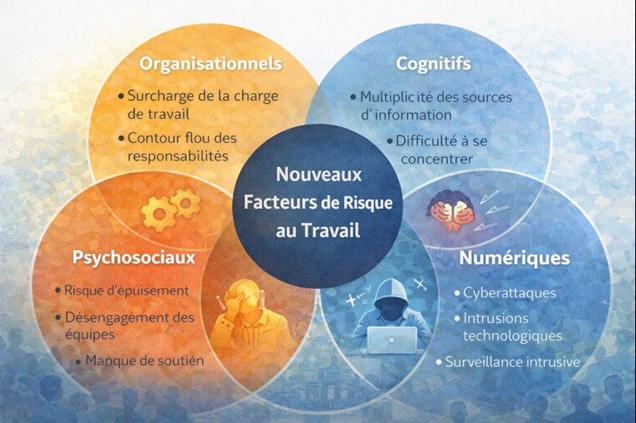
Changes in Work and New Risk Factors
Work is undergoing profound change. Automation, artificial intelligence, hybrid work, extended subcontracting, and performance pressure are transforming real working situations. These developments give rise to new risk factors:
- cognitive and attentional overload,
- dilution of responsibilities,
- loss of collective reference points,
- increased interaction between human, organizational, and technical risks.
These risks are not always immediately visible, but their effects unfold over time.
The Limits of Traditional Prevention Approaches
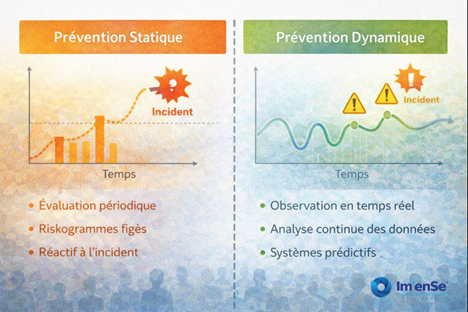
Traditional prevention approaches are still largely based on static snapshots of risk: periodic assessments, fixed reference frameworks, and standardized procedures. Today, however, these approaches are reaching their limits.
- rapid variations in working situations,
- the cumulative effects of multiple constraints,
- weak signals that precede deterioration.
Prevention can no longer afford to react only after incidents occur.
Towards Dynamic and Predictive Prevention Tools
From 2026 onward, prevention is moving toward more dynamic, continuous, and predictive systems. The objective is not to replace human judgment, but to better support decision-making.
- analysis of field data,
- real-time observation of working situations,
- early detection of organizational drift.
Prevention becomes a living system, capable of evolving alongside work itself.

Impacts on Training and Safety Culture
This evolution profoundly transforms training and safety culture. The expected competencies are no longer limited to knowing rules, but include the ability to:
- understand complex situations,
- make decisions under constraints,
- cooperate and report emerging risks.
Safety culture becomes more collective, learning-oriented, and adaptive. The role of management is central: providing meaning, encouraging reporting, and integrating prevention into strategic decision-making.
Emerging risks are redefining prevention in Europe. From 2026 onward, prevention can no longer be purely normative or top-down. It must become anticipatory, systemic, and deeply rooted in the real functioning of organizations.
Evolving prevention means accepting that safety is no longer just an obligation, but a lever for resilience, performance, and sustainable trust.